Author: April Joy Mansilla
I enter the unit armed with a cart of creative tools. These are not just brushes and paints, but instruments of self-expression and hope, my hope and theirs.
I am an expressive arts teacher in Acute Psychiatry at St. Joseph’s Healthcare Hamilton. But I was also once a patient in their very shoes. I remember hearing the words Bipolar I for the first time and the fear that word held. All I knew of mental illness came from movies and books. I had never met anyone with Bipolar I who was living well.
Yet here I am now, an example of how far you can go with the compassionate care of staff, family, and a world willing to see more than a diagnosis. When I tell patients that I was once here too, their eyes light up. That spark…that’s hope. It’s the beginning of a bigger picture of what living with mental illness can look like.
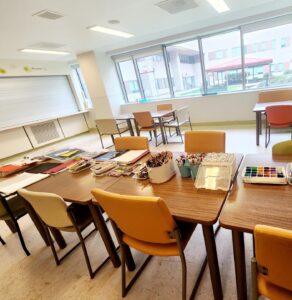
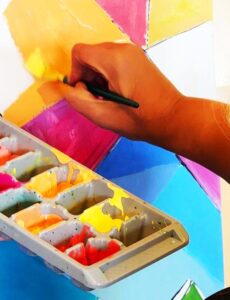
Our classes begin with music chosen by the patients. I want them to know this is their time, their voice. I spread the table with paints, pencils, markers, and more, so they can choose, because even small choices are powerful first steps in recovery.
Many arrive in crisis, withdrawn, grieving identity, or struggling to trust their own voice. In these locked units, where autonomy is stripped away by necessity, art becomes one of the few spaces where a person can choose, create, and be seen. I have watched lights return to patients’ eyes with art. I have seen a racing mind focus through brushstrokes. I have seen people who believed they were “too far gone” rediscover dignity and connection through our collaborative mural groups. I have seen individuals with bipolar disorder channel manic energy into extraordinary artwork and later return to it as a reminder of their strength in recovery.
How we see ourselves determines how we live; how others see us helps us recover.
I know this because years ago, Sharon Simons, the manager of the unit where I was treated, looked at me and saw more than an illness; she saw potential. I was a fine artist, and she believed I needed a path to stay well. She didn’t see my past as a weakness but as a strength. With her mentorship, I began working in mood disorders and later taught throughout the community. This summer, Sharon, along with manager Taralynn Filipovic and Director Heather Radman, invited me to teach in Acute Psychiatry. It was the first time an art teacher had worked in that acute unit. Of course, I said yes.
Leadership matters. It demonstrates, by example, that recovered patients can play a crucial role in the well-being of others. It also gives individuals like me a purpose to stay on the recovery path and to use our illness in a way that defines us positively.
I know people often fear what they don’t understand, or what movies have taught them to believe about mental illness, especially acute. But even in the chaos of the ward, when the paint comes out, so does the calm. Patients feel their worth through art, and through my words; I was here. I lived in your shoes. And I am here because I believe you can be more.
The other day, a patient told me, “Thank you for not being scared of us. We’re more scared of ourselves.” And I replied, “I can’t be scared of what I am.” I know too well the fear of being seen as dangerous. We are not dangerous; our untreated illness is mostly to ourselves. Programs like this help combat stigma and offer something else, a sense of belonging.
For a full hour, patients create as music plays, encouraging one another. The art table becomes a place of welcome, where every voice is valued and matters.
And with all of this, I find healing, too. I carry the perspective of standing on both sides of the psychiatric door. When patients help me pack up my supplies and I leave the unit, I always think, I hope you get to see the world the way I do.
A diagnosis isn’t a life sentence. It can be a way to see the world in a different light, perhaps even more vibrantly. We need people like us not to move on in silence, but to show up loudly and proudly and say,
This is my life with bipolar.
It is beautiful, it is colourful, and it is all mine.