How has your understanding of bipolar disorder changed over time?
In all honesty, I did not have a true understanding of “what” Bipolar is outside of the typical portrayal in various forms of media. My understanding was limited to “mood swings”, “manic depression” and “being difficult to deal with”. Stigmatized viewpoints of bipolar dominated my perception and made me resistant to seeking help in the form of therapy and medication. I only had the opportunity to learn how it manifests itself in one’s life during, and after, experiencing my first psychotic breakdown at the age of 28. In hindsight, symptoms started to appear during puberty, and gradually worsened over the years until finally seeking treatment. The turning point for me occurred after incurring PTSD working in the ICU as a registered dietitian during the COVID pandemic – only truly manifesting itself 3-4 years after these events, and in conjunction with other factors resulted in my eventual breakdown. Through engaging in open and honest dialogue about needing help I was able to take the first step and begin my treatment journey. Bipolar is as much a part of me as my eye colour or laugh, but it can also be managed with an accepting perspective and the right support.
What role does community or connection play in your recovery?
Community is what kept me alive. Not in the sense that I would certainly have committed serious self-harm if I had not had support, but in a more insidious way where I truly do not know what would have happened without it. Psychosis is difficult to deal with and community, love and support may not completely ameliorate these symptoms – but it plays a critical role in ensuring you can experience these symptoms in a safe environment. Community reminds you that there is a life outside of your detrimental feelings, and that while the emotions you may experience are real to you in the moment, they are also transitory. The support of those who love and care for you can be the lighthouse on the shore that allows you to steer yourself home through the storm – the hardest and most freeing thing you can do is to extend a hand, trust, and let them. Finding a way to channel your intense emotions and share them with the world can be an excellent form of decompression in itself – be it painting, writing, music etc. Express yourself – it is more important for you than most.
How do you remind yourself that progress isn’t linear?
To console myself on bad days, and keep me grounded on others I try to remind myself that life itself is an ebb and flow. Every day cannot be sunny, and even flowers pray for rain – sometimes. While the manic highs and crushing lows may be gut wrenchingly difficult to deal with – there is an inherent value in being obstinate. Refusing to give up despite these obstacles, is enough on some days. Choosing to believe that you possess an inherent value despite the range of emotions you may experience desperately working to convince you otherwise is a battle that few people will understand – but this doesn’t mean that they cannot help. Therapy is not about making life easy, it is about equipping yourself with the tools to help you cope when things inevitably become hard. Possibly the most important skill I have learnt is that silence and isolation are never a better option than reaching out for help, and your supporters will never begrudge an earnest request for help. You are not a burden, and you have a unique perspective on the world that often delves deeper than most neurotypical people are able to visualize.
What’s something people might be surprised to learn about living with bipolar disorder?
You are far less alone than you feel. Bipolar can make you feel like the weight of the world is on your shoulders, but this is not something you need to carry alone. Speaking through issues with therapists and appropriate treatment as advised by your psychiatrist can change your view on life. It allowed me to see a future for the first time, whereas before all I could see was worry and heartache. Chances are, there are people in your life who have also struggled with various flavours of mood disorder, but have been too scared or embarrassed to share this for fear of stigmatization. Find your community and love them fiercely. Carrie Fisher (Princess Leia herself) struggled. Stephen Fry struggled. Richard Dreyfus. The list goes on, but the point I would like to illustrate is that bipolar shouldn’t feel like something that should stop your journey – it might just result in you taking the ‘emotional scenic route’ sometimes. Since my diagnosis I have had the courage to take up pursuits I was too fearful to enjoy when I was untreated – painting, print-making and writing, and am so grateful that I now have the courage to pursue what I love.
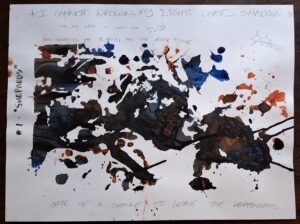
Below is some of Gareth’s beautiful artwork: