
Something I am proud of in my journey:
My name is Maria Winfield.
I live with Bipolar 1 Disorder.
The thing I’m most proud of in my journey managing bipolar disorder is becoming a Mental Health Advocate after hiding my diagnosis for nearly two decades.
I was diagnosed in 1999. I took medication for a while but felt I didn’t need it. However, in 2003, I experienced my first episodes of mania and psychosis. I didn’t sleep for days and walked out of my New York City apartment in the middle of the night. Much of it is still a blur, but I remember coming out of a trance-like state and hearing a voice say, “you need help.” I walked into a hospital Emergency Room and repeated the words I’d heard, “I need help.” I woke up the next night and the nurses told me that they’d given me Haldol, a powerful antipsychotic. That scared me into taking my medicine, as prescribed, but it would take more than two years of going in and out of hospitals for the doctors to find the right medicine combination, but eventually, I got stable and I moved to Los Angeles.
For 18 years, I took my medicine, saw my doctor each month, and went to therapy once a week. I thought I’d beaten bipolar disorder. I didn’t tell anyone in my new life. Bipolar disorder was my secret and if no one knew, I told myself there was nothing to be ashamed of, but I always knew on some level that wasn’t true.
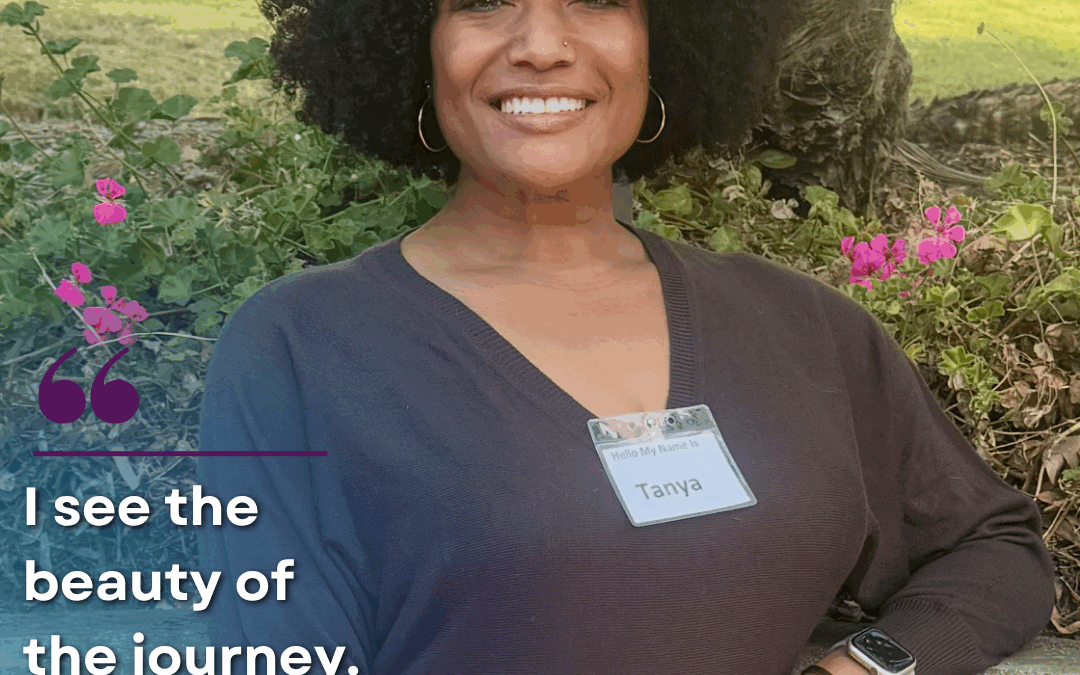
Then came the COVID-19 pandemic hit. Like so many others, my mental health spiraled down. I was under a lot of pressure because of my job and In 2023, I experienced my second episodes of psychosis and mania. I had to be involuntarily hospitalized. My relapse was exponentially worse than my first episodes. I had long periods of time when I didn’t know if I would or even could recover. Thankfully, I’d heard of NAMI – The National Alliance on Mental Illness – and I dove in . The peer support and presenter trainings enabled me to walk through the shame and find purpose in surviving. As a Mental Health Advocate, I share my story and I see the beauty of the journey. Some days are harder than others, but I know doing this work keeps me focused on my own mental health and wellness every day.
Message for those who are newly diagnosed:
I still remember what it felt like to be newly diagnosed with bipolar disorder. I can still feel the heat on my face as I stared at the doctor first in shock and disbelief, then anger, and finally fear. Would I have a “normal” life? After learning about bipolar disorder and reading books by people living it, there was a calm in having an answer for thoughts and behaviors that I couldn’t understand or stop. Then, once the medications began to work, I accepted that yes, I had bipolar disorder. Still, I wanted to be someone who didn’t need medications. I am grateful that my first episodes ended with me being guided to the hospital instead of ending in tragedy. I have heard the stories from many peers. Medicine compliance is something many of us have struggled with, especially in the beginning. Today, I see medicine and treatment as the solution, not a problem. Fighting stigma has become one of the cornerstones of my mental health advocacy. Today, I know the most important thing is to do everything I can to stay stable and have a productive, joyful life.
